
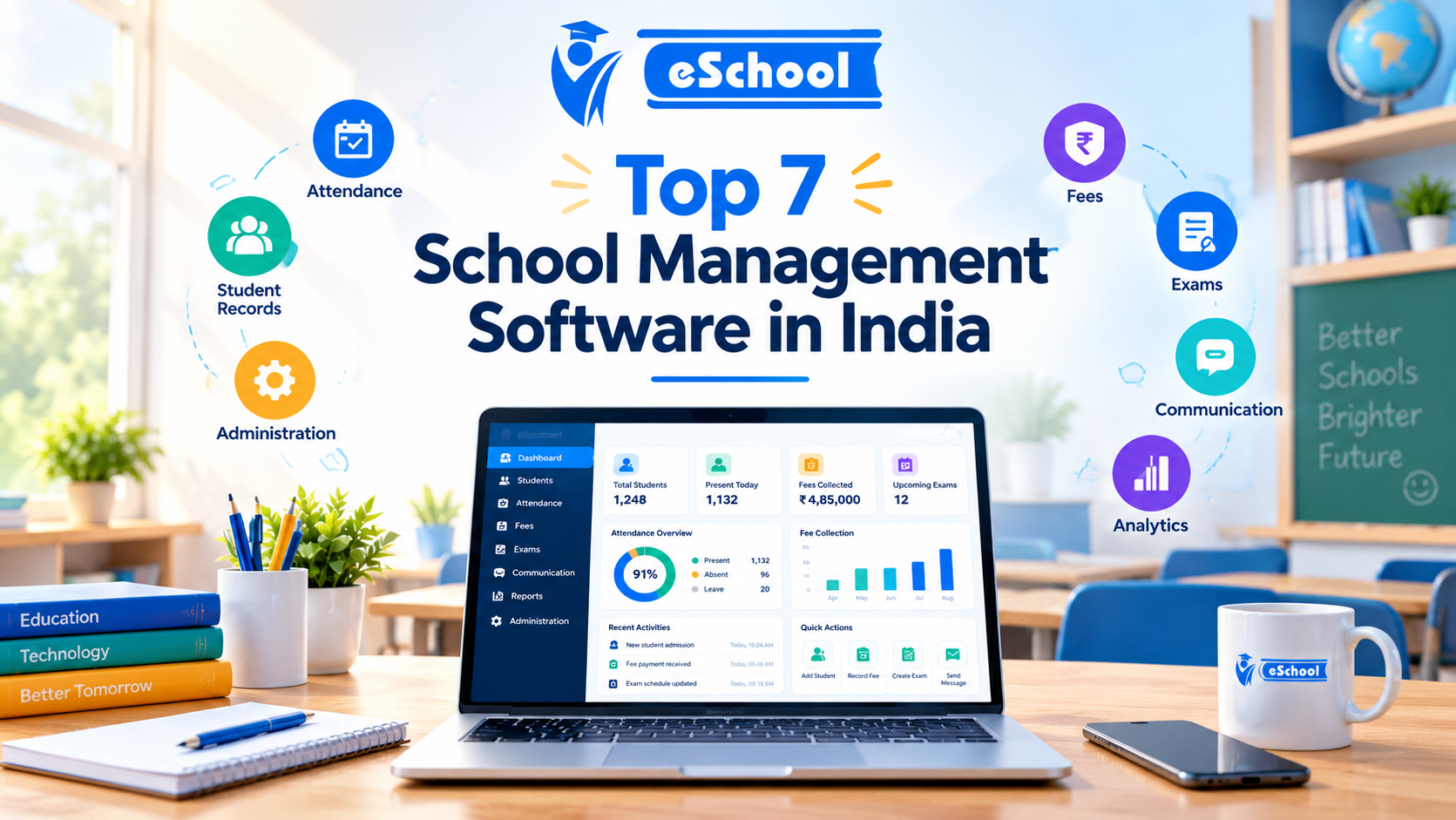
It’s not an easy task to run a school. In addition to many other everyday responsibilities, schools must oversee students, teachers, attendance, fees, tests, assignments, parents, and communication.
School management software in India can be useful in this situation. It unifies numerous educational activities into a single online platform. Schools can handle critical tasks from a single location rather than utilizing numerous registers, spreadsheets, and different applications.
However, what software ought a school to select?
The Top 7 School Management Software in India will be examined in this article, along with their functions, key advantages, and methods for schools to select the best system.
What Is School Management Software?
A digital application called school management software helps schools organize their daily tasks online.
Schools can use it to manage student records, attendance, fees, tests, assignments, correspondence, admissions, staff data, and more.
It functions similarly to a digital school office, to put it simply.
It can be used by teachers for assignments in the classroom. It can be used by school administrators to run the school. Important updates can be sent to parents. Students have access to educational resources.
In India, a smart school management system may cut down on paperwork and save time.
Why Do Schools Need a School Management System?
Notebooks, Excel files, paper forms, and various apps are still used for various activities in many schools. School administration may become challenging as a result.
A school management system centralizes crucial data.
Schools utilize school management software for the following main reasons:
- To cut down on paperwork
- To save staff members’ and instructors’ time
- To handle student data
- To monitor attendance
- To oversee educational costs
- To administer and oversee tests
- To speak with parents
- To organize study materials and assignments
- To make admission easier
- To maintain order in school records
Schools should compare the features of each program before selecting one because they differ.
Top 7 School Management Software in India
1. eSchoolApp
A school management Software called eSchoolApp was created to assist schools in handling many administrative and academic tasks from a single platform.
In areas including student data, attendance, fees, exams, communication, educational activities, and parent involvement, it can help schools.
The ability to employ digital resources to connect schools, teachers, students, and parents is one beneficial aspect of a contemporary educational system.
Why think about eSchoolApp?
Schools can benefit from eSchoolApp:
- Organize student data
- Monitor attendance
- Control fees
- Manage tests and findings
- Distribute study materials and assignments.
- Talk to the parents
- Oversee educational activities
- Cut down on paperwork
- Organize your information.
eSchoolApp is one choice for Indian schools searching for a basic school management system.
2. Fedena
Fedena is a platform for school administration that offers resources for handling various school-related tasks.
Student data, attendance, fees, exams, correspondence, and other administrative tasks are some of its characteristics.
It is intended to combine many educational procedures into a single online platform.
Before choosing the software, schools should consider its current features, cost, support, and applicability.
3. MyClassCampus
For educational institutions and schools, MyClassCampus offers digital resources.
Exams, communication, attendance, fees, student management, and other school-related issues can all benefit from it.
Reducing manual labor and assisting schools with digital information management are two of these systems’ primary goals.
4. Entab CampusCare
A platform for handling various school procedures is called Entab CampusCare.
It provides resources on topics like student data, attendance, fees, tests, correspondence, and school management.
Schools can assess its characteristics according to their workflow, budget, size, and needs.
5. Teachmint
Teachmint offers digital resources for education and school administration.
Teaching, communication, classroom activities, and other education-related needs can all be supported by its platform.
Before choosing a digital platform, schools should weigh its features against their unique needs.
6. LEAD
LEAD offers educational and technological solutions to schools.
Schools can benefit from its solutions in areas including teaching, learning, academic management, and school operations.
When contemplating an educational technology platform, schools should analyze the entire solution and determine whether it meets their administrative and academic requirements.
7. SchoolPad
SchoolPad offers digital solutions for educational institutions, such as software that facilitates school management and communication.
Schools can compare its features with those of other school management platforms based on their needs.
It’s crucial to review the features, cost, customer service, training, and data security of any software before choosing it.
What Features Should School Management Software Have?
Nonetheless, a good school management system often consists of a number of crucial parts.
1. Management of Students
Important student data can be digitally stored by schools.
This could consist of:
Name of the student
Section and class
Contact information
Details about parents
Academic background
2. Management of Attendance
Students’ attendance can be digitally recorded by teachers.
Additionally, school officials do not need to check numerous paper registers to view attendance records.
3. Management of Fees
Software can be used by schools to keep track of fees, payments, receipts, and unpaid fees.
Both parents and schools may find it easier to handle fees as a result.
4. Exam Administration
Exams, grades, outcomes, report cards, and academic records can all be managed with the use of a school system.
5. Parent Communication:
Schools can use software to share:
Announcements and Notices
Updates on attendance
Assignments
Exam details
School-related activities
6. Assignments and Educational Resources
Instructors can digitally distribute assignments, comments, homework, and study materials.
The information is available to parents and students as needed.
7. Management of Admission
Admission forms, student applications, and admission records can all be managed by schools with the use of certain school administration systems.
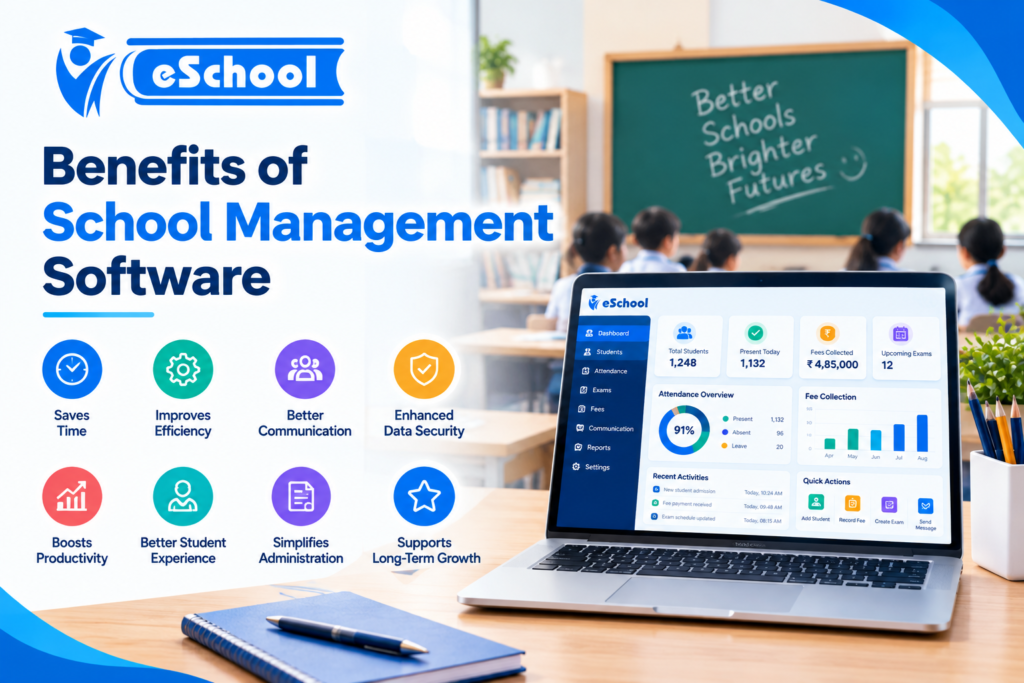
What Are the Benefits of School Management Software?
Regular communication between schools and parents is necessary.
Schools can use software to share:
Announcements and Notices
Updates on attendance
Assignments
Exam details
School-related activities
Conserves Time
It is not necessary for educators and school personnel to perform the same tasks in many registers and files.
Minimizes Paperwork
Instead of utilizing a lot of paper, important information can be digitally preserved.
Enhances Interaction
Parents and children can receive updates from schools faster.
Organizes Information
Information about students and schools can be kept in an organized way.
Assists Teachers
Attendance, homework, grades, and other classroom duties are easier for teachers to handle.
Assists Parents
Parents don’t necessarily need to visit the school to get crucial school information.
Assists Educational Leaders
Reports and digital records can help administrators better understand school operations.
How Does a School Management System Work?
School-related activities
Step 1: The school sets up accounts for parents, instructors, administrators, and students.
Step 2: Information about students and schools is entered into the system.
Step 3: For everyday work, teachers and staff utilize the pertinent modules.
Step 4: Using the digital resources at their disposal, parents and students obtain information.
Step 5: School administrators are able to oversee school operations and view reports.
This establishes a single, integrated system for various school personnel.
How Should You Choose School Management Software in India?
School-related activities
First, ascertain the true needs of your institution.
Verify these points:
1. Characteristics
Verify if the program provides the features your school requires.
2. Simple to Use
The system should be easy for staff members and teachers to learn.
3. Access via Mobile
Verify whether users can utilize mobile devices to access crucial information.
4. Characteristics of Parents
Seek resources that facilitate easy contact with parents.
5. Documents
Effective reports can aid administrators in comprehending crucial school data.
6. Security of Data
Information about students and schools is crucial. Inquire about the company’s data storage and protection policies.
7. School-related activities
When administrators or instructors encounter difficulties, good assistance can be helpful.
8. Cost
Examine the package’s features and services in relation to the price.
Is School Management Software Useful for Small Schools?
School Management Software can also be used in small schools.
Some features might not be necessary for a small school. Important tools, including student management, attendance, fees, exams, and parent communication, can be used as a starting point.
The school can employ more digital features as it expands.
Selecting software that fits the real demands of the school is crucial.
eSchoolApp: Helping Schools Move from Paper to Digital
School Management Software can also be used in small schools.
The program ought to simplify daily tasks.
This is where eSchoolApp’s digital school management technologies may help schools.
A linked school system can facilitate collaboration between several parties on everything from student data and attendance to fees, exams, educational activities, and communication.
The objective must be straightforward:
fewer documents. improved dialogue. simpler administration of schools.
What Do Schools and Users Say?
School Management Software can also be used in small schools.
After switching from manual to digital work, schools and users could provide the following kinds of feedback:
“Sharing school updates with parents is much simpler. We don’t have to rely just on paper notices.
— Administrator of the School
“Digital student information and attendance management saves time during our daily school work.”
— Instructor
“Parents don’t need to call the school for every little question in order to receive important updates.”
— Parent
These illustrations highlight the typical advantages that schools seek when switching from manual to digital school administration.
With the consent of the customer, schools should use verified customer feedback for published marketing testimonials.
Final Thoughts:
School Management Software can also be used in small schools.
From a linked digital platform, it can assist schools in managing student data, attendance, fees, tests, assignments, communication, and other everyday tasks.
Compare the features, usability, cost, support, security, and real demands of your school before selecting a school management system in India.
eSchoolApp is one choice for educational institutions searching for a digital platform.
The proper software shouldn’t complicate school administration. It should make daily tasks easier, quicker, and more structured.
Frequently Asked Questions:
What is the best School Management Software in India?
School management software can also be used in small schools.
One tool for managing students, attendance, fees, tests, learning, and communication is eSchoolApp.
What type of software is essential in schools?
School management software can also be used in small schools.
Exams, homework, attendance, fees, student records, correspondence, and other school-related tasks can all be managed by it.
What is the best way to pay school fees?
School management software can also be used in small schools.
It can assist parents in keeping track of their payment records and offer digital receipts.
How much does school management software cost in India?
School management software can also be used in small schools.
Schools should evaluate prices according to their unique needs.