
🌍 Introduction
Technology is revolutionising the way students are taught and how teachers instruct. Nowadays, schools are moving away from traditional teaching methods and blackboards. They are using smart classrooms, which make learning more dynamic, enjoyable and efficient.
Modern schools are also utilising AI-based learning systems, AI teaching tools,and school ERP, as well as AI-powered learning solutions, to enhance the quality of education and school management. These tools help students comprehend lessons better, aid teachers in their daily duties, and make school activities easier.
In this article, we will explain what smart classrooms are, how they function, why schools require them, and the benefits they offer to teachers, students, and administrators.
🎯 What Are Smart Classrooms?
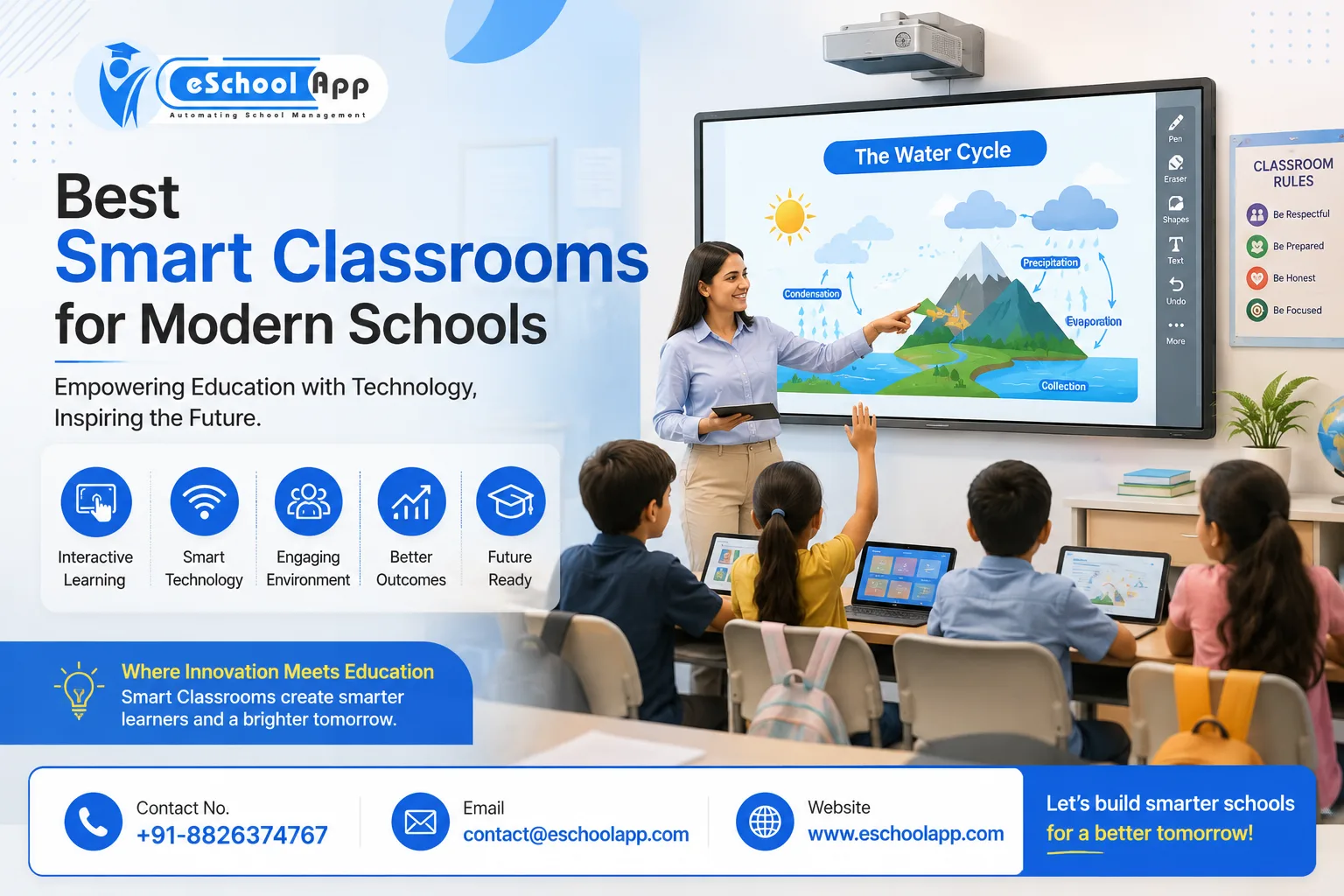
Smart classrooms are spaces for learning that have technology that makes use of digital tools to make learning and teaching more engaging.
Instead of relying on chalkboards and textbooks, teachers can utilise the following:
- Interactive displays
- Digital whiteboards
- Animations and videos
- Educational apps
- Online assessments
- AI teaching tools
- AI-based learning systems
These tools assist students in grasping complex concepts better and make learning more engaging.
Simple Example
Imagine learning more about how the sun works.
In the typical classroom setting, the students might only look at pictures in textbooks.
In the Smart Classroom, students can view 3D animations, visit virtual planets and take part in interactive tests.
Learning can be fun and memorable.
🤖 How Do Smart Classrooms Work?
Smart classroom hardware combines well with software and internet-based technology.
Common components are:
✅ Smart boards
✅ Projectors
✅ Tablets and computers
✅ Digital learning content
✅ AI-powered learning platforms
✅ Learning management systems
✅ School ERP software
Teachers can teach lessons using digital technology, track student progress and customise learning experiences.
Students can take part in active learning through video tutorials, quizzes and other collaborative activities.
💡 Why Are Smart Classrooms Important for Modern Schools?
The field of education is evolving rapidly.
Today’s students are being surrounded by technology. Learners are more successful when their lessons are interactive, visual and personalised.
Smart classrooms help schools:
- Improve student engagement
- Enhance the learning outcomes
- Support different learning styles
- Students should be prepared for the digital age
- Reduce administrative workload
Schools that adopt technology improve learning and remain ahead of the curve in the world of education.
🚀 Benefits of Smart Classrooms
📖 1. Better Student Engagement
Students can lose their focus when they are in long classes.
Through AI-powered learning, including videos, simulations, and interactive exercises, learning experiences become fun.
When students love studying, they are able to pay closer attention and are able to retain more information for longer.
🎓 2. Personalised Learning for Every Student
Each student learns differently.
Some people learn quickly, whereas others require additional help.
AI-based learning systemsare able to analyse the performance of students and suggest learning materials according to individual requirements.
This helps each student learn at their own pace.
👩🏫 3. Improved Teaching Experience
Teachers spend many hours creating lessons and checking homework.
The use of AI teaching tools can be helpful by:
- Creating quizzes
- Generating lesson plans
- Assessment of student performance
- Learning recommendations
Teachers can now focus on mentoring and teaching students.
📊 4. Real-Time Performance Tracking
Teachers and parents are able to track the progress of their students instantly.
With dashboards and reports integrated, schools can identify early learning gaps and provide extra support.
It leads to improved academic performance.
🌍 5. Access to Global Learning Resources
Students can access educational materials from all over the world.
You can:
- View educational videos
- Virtual classes
- Explore digital libraries
- Online learning is a great way to learn.
The knowledge they gain is far beyond what traditional textbooks can provide.
⚡ 6. Faster School Management
Running a school is not just about teaching.
Time and effort are also required to manage admissions, attendance fees, exams, and communications.
School ERPsolutions are extremely valuable in this area.
🏢 What Is a School ERP?
A school ERPplatform is a digital tool that allows schools to manage their daily operations more efficiently.
All school activities are consolidated into one system.
Some of the most common features include:
- Attendance management
- Fee Management
- Exam management
- Student Records
- Staff Management
- Parental communication
- Transport tracking
When combined with smart classrooms, an ERP for schools creates a digital school ecosystem.
🔍 How School ERP Supports Smart Classrooms
Modern schools need both efficient teaching and effective administration.
A school ERP supports smart classrooms by:
✅ Manage Student Data
Teachers can access student records quickly.
✅ Monitoring Attendance
Automatically generated attendance reports.
✅ Tracking Academic Performance
Schools can monitor the learning outcomes of their students and identify areas that need improvement.
✅ Improving Parental Communication
Parents are informed about homework, school events, and attendance.
🤖 Understanding Artificial Intelligence in Education
Artificial intelligence in education is the use of AI technologies to enhance learning and teaching.
AI can be:
- Analyse the student’s behaviour
- Study materials are recommended
- Automated assessments
- Instant feedback
- Customize learning paths
Students can receive support at the right time.
🧠 How AI in the Classroom Helps Students
The use of AI in the classroom is transforming how students learn.
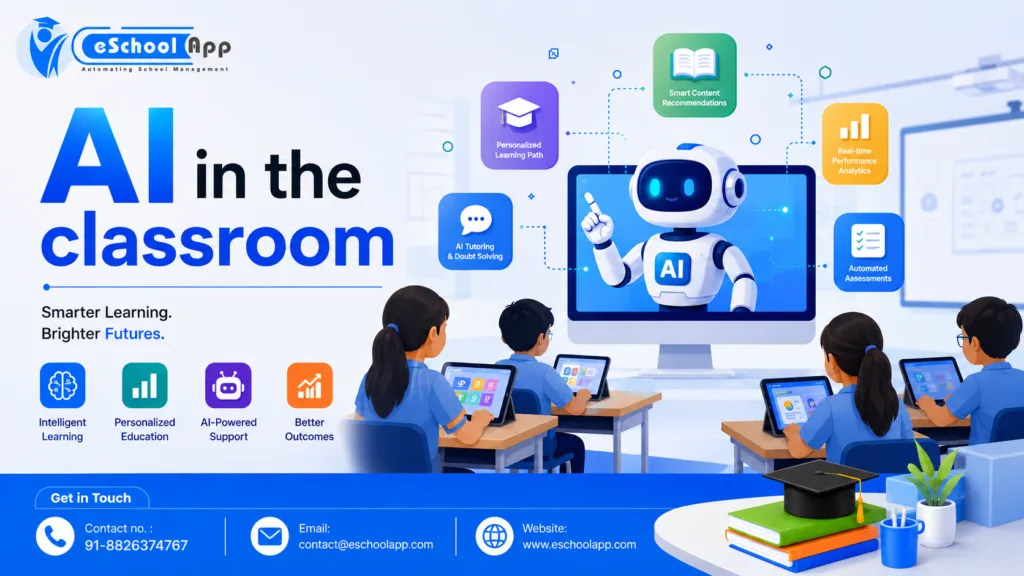
AI benefits students in the following ways:
📚 Providing Personalised Lessons
AI can identify strengths and weaknesses and suggest tailored learning activities.
🎯 Instant Feedback
After completing quizzes or assignments, students receive immediate feedback.
⏰ Supporting self-paced learning
The students can review lessons at any time.
🌟 Improve Confidence
Students can learn more effectively with personalised support.
👩🏫 How AI Teaching Tools Support Teachers
Every school is built on its teachers.
Teachers can save time by using modern AI teaching tools to improve classroom efficiency.
These tools are:
- Create lesson plans
- Generate worksheets
- Design assessments
- Track student progress
- Learning resources to recommend
Teachers can now spend more time with their students.
📈 Why Schools Are Adopting Smart Classrooms
Schools are using technology to improve the quality of education.
The following are some of the main reasons:
✅ Better student outcomes
✅ Improved teacher productivity
✅ Enhanced parent engagement
✅ Efficient school administration
✅ Digital transformation initiatives
✅ Growing demand for modern education
To remain competitive, schools invest in smart classrooms and AI-powered learning.
🖥️ The Role of School Management Software
Educational success is dependent on effective administration.
Modern school management software helps schools:
- Reduce paperwork
- Automate repetitive tasks
- Communication is key to success
- Securely manage records
- Generate reports quickly
Integrating school ERP into school systems can increase efficiency and transparency.
🌟 Why Choose eSchoolApp for Smart Classrooms?
eSchoolApp is a digital education technology solution that helps schools embrace the digital transformation.
The platform supports:
✅ Smart Classrooms
✅ AI-based learning systems
✅ AI teaching tools
✅ School ERP
✅ School management software
✅ AI-powered learning
eSchoolApp combines teaching innovation with administrative efficiency to help schools improve learning for students.
🗣️ What Schools Say About eSchoolApp
⭐ Testimonial
“Our classrooms are more interactive and engaging since implementing eSchoolApp. Teachers can save time using AI tools. Parents are kept informed by the ERP system. And students learn more than ever.
— Principal, Leading CBSE School, India
🎯 Final Thoughts
The future of learning is digital, intelligent and interactive. Smart classrooms help schools create engaging learning environments for students.
Schools can improve their academic performance as well as operational efficiency by combining AI-based learning systems, AI teaching tools, AI-powered learning, artificial intelligence in education, school ERP,and advanced school management software
eSchoolApp is a powerful solution for schools that want to modernise their education and prepare the students for tomorrow. It combines technology, teaching, and management into one platform.
❓ FAQ
Q.1 What are smart classrooms?
Ans: Smart classrooms are technologically enabled classrooms that use digital tools, AI technology, and interactive content to improve teaching and learning.
Q.2 How do AI-based learning systems help students?
Ans: AI-based Learning Systems Personalise Education by Analysing Student Performance and Recommending Learning Content Based on Individual Needs.
Q.3 What is the role of AI in the classroom?
Ans: AI in the classroom automates tasks, provides instant feedback, individualises learning, and supports teachers to deliver better lessons.
Q.4 Why is school ERP important?
Ans:A school ERPsimplifies the administration of schools by managing attendance, fees and exams; communication with students; and records.
Q.5 Can smart classrooms improve learning outcomes?
Ans:Yes, smart classrooms can increase student engagement and support personalised learning. They also help teachers deliver more effective lessons.