
Introduction
A school bus running late can leave parents waiting at stops, calling the front office and wondering whether their child has boarded. A school bus tracking system can make transport information easier to access, but a moving dot on a map is only part of the solution.
Parents need reliable information about the bus assigned to their child, the expected pickup point and changes to the normal schedule. School administrators, meanwhile, need a way to identify transport problems without repeatedly calling drivers during their journeys.
The starting point is accurate route information, dependable location updates and clear communication when something changes. Technology should support the school’s transport procedures rather than replace them.
On this page
- Build accurate routes and stop records
- Make live GPS information useful to parents
- Send alerts that parents can act on
- Handle delays and unexpected route changes
- Establish responsibility for transport data and safety
- How eSchoolApp Transport Tracking Can Be Evaluated
- Frequently Asked Questions
- Final Thoughts
Build accurate routes and stop records
Tracking becomes difficult to use when the underlying transport records are incorrect. Every active route should have an identifiable vehicle, an ordered list of stops and a current list of students assigned to those stops.
Use stop names that parents recognise. A familiar landmark near a residential society may be more helpful than a technical location description, provided the exact boarding point is also clearly established.
Morning pickup and afternoon drop routes may follow different sequences. Schools should maintain separate information where necessary instead of expecting families to interpret a common route schedule for both journeys.
Before the academic session begins, the transport coordinator should review assignments with the drivers and attendants. Any student changing residence, leaving the transport service or moving to another route should have their records corrected promptly.
Make live GPS information useful to parents
Live tracking should help families decide when to leave home for the bus stop. It should also help transport staff understand where a vehicle is when responding to a parent’s enquiry.
Location information is not equally reliable throughout every journey. Mobile network interruptions, device faults and delayed data transmission can cause a vehicle’s displayed position to differ from its actual position.
Schools should assess whether parents can distinguish recently updated information from an older location. An outdated position without a visible explanation may create more confusion than having no tracking information at all.
A map location also does not establish whether a particular child has boarded the vehicle. Staff should explain this distinction to parents and maintain appropriate boarding and handover procedures independently of GPS tracking.
For further background on how vehicle location technology fits into transport operations, read about GPS vehicle tracking for schools.
Send alerts that parents can act on
Transport alerts are useful when they tell families something relevant to their immediate plans. Messages about an approaching bus, a significant delay or an approved change of pickup point can help parents decide what to do next.
Before configuring alerts, decide which transport events deserve a message. Sending frequent notifications that require no action may encourage parents to ignore important updates later.
The wording should identify the relevant route or stop and explain any action expected from the parent. Where arrival times are estimates, the message should not present them as confirmed timings.
Schools should also account for families who do not regularly check the school app. Evaluate whether alternative communication channels are appropriate, during unexpected disruptions. Agree on who will contact parents if automated communication is unavailable.
Handle delays and unexpected route changes
Normal traffic congestion, road closures, heavy rain and vehicle problems can disrupt even a carefully planned route. A tracking arrangement should be evaluated against these situations, not just against a journey that runs on schedule.
The transport coordinator needs a procedure for receiving information about disruptions and deciding whether parents must be notified. Establish who can approve temporary stops, replacement vehicles or changes to the route.
When a replacement bus is deployed, its location information should not be confused with that of the original vehicle. Staff should verify that affected families know which vehicle is collecting or dropping their children.
For more serious incidents, schools need a separate emergency response procedure with verified contact details and clear responsibilities. Parents should know whom to contact, and drivers should not be expected to answer routine calls while driving.
After a disruption, review whether information reached the right families and whether staff had access to accurate records. Use the findings to improve the procedure.
Establish responsibility for transport data and safety
Someone must be responsible for maintaining transport records after the initial setup. Without clear ownership, old stop assignments and incorrect parent contact details can remain in use long after circumstances change.
The front office can collect requests for transport changes, while the transport coordinator verifies and approves operational changes. A designated administrator should review unresolved discrepancies and ensure that staff know which records to follow.
Access to vehicle locations and student transport details should be limited to people who need them. Schools should evaluate how parent access is restricted to relevant journeys and how permissions are withdrawn when a student stops using the service.
Tracking should complement vehicle maintenance, driver supervision, attendant responsibilities and safe boarding practices. It is a source of operational information, not proof that every child is safe or that every transport procedure has been followed.
How eSchoolApp Transport Tracking Can Be Evaluated
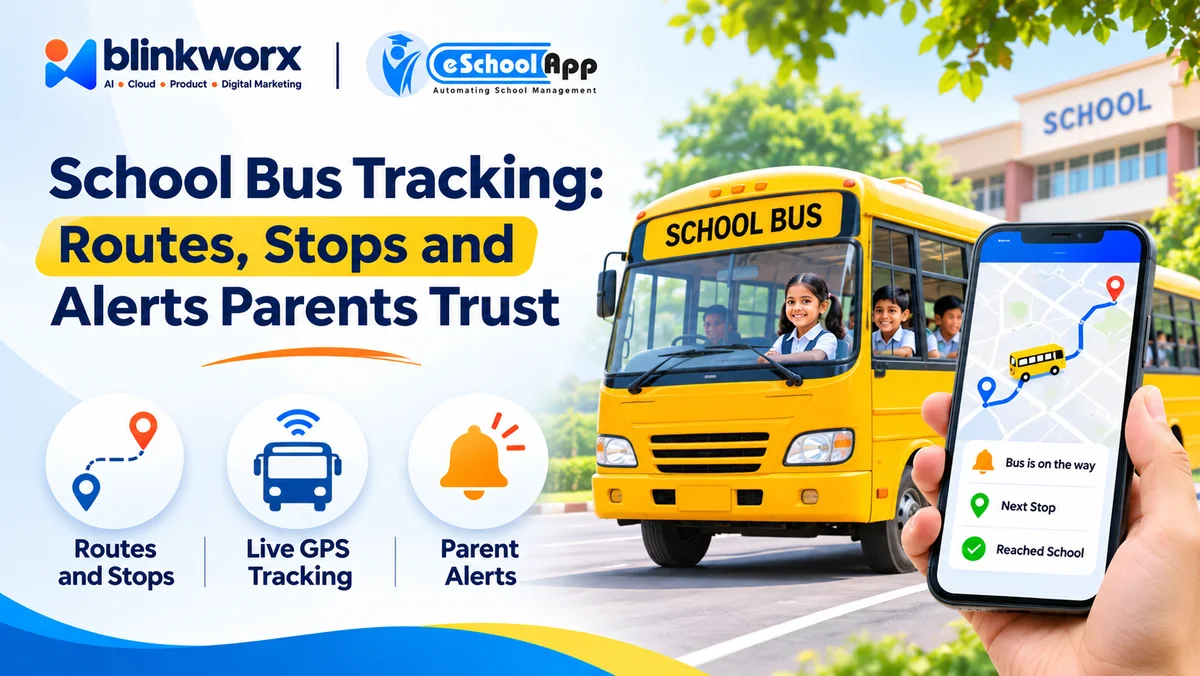
The eSchoolApp Transport Management module includes live GPS tracking, parent alerts, routes and stops. Schools considering it should request a demonstration based on their actual transport arrangements.
Ask the demonstrator to configure a sample route with familiar stops and assign students to it. Check what parents can see, how location updates appear and how the system behaves when a GPS tracker stops transmitting information.
eSchoolApp has integrations available for GPS trackers, WhatsApp and SMS. Confirm compatibility with the school’s existing tracking devices and ask which alert events and communication channels can be configured for the proposed implementation.
The software uses a shared student record across its modules, so a detail corrected once is corrected everywhere. Ask to see how a corrected student detail appears in transport records and whether changing a stop assignment requires any additional approval or configuration.
Before wider deployment, test a limited set of routes and collect feedback from parents and transport staff. Evaluate the accuracy of the information, clarity of alerts and the effort required to maintain records.
Frequently Asked Questions
Can parents track their child’s school bus in real time?
Live GPS tracking can show the location of a vehicle as updates are received. Its accuracy and timeliness depend on the tracking device, connectivity and system configuration.
Does GPS tracking confirm that a child has boarded the bus?
No. GPS identifies the vehicle’s location, not the presence of an individual student. Schools need a separate process for checking boarding and drop-off.
Can schools use their existing GPS tracking devices?
Compatibility depends on the device and the software’s available integrations. Schools should confirm the exact tracker model and test it before implementation.
What happens if the bus loses mobile network connectivity?
Location updates may be delayed or interrupted. Schools should check how the system displays outdated information and maintain an alternative communication procedure.
Should parents receive an alert for every stop?
Usually, parents need information relevant to their child’s assigned stop rather than every stop on the route. Schools should evaluate alert settings against actual family requirements.
Who should maintain school bus route information?
The transport coordinator should generally own operational route records, with support from the front office for student and parent information. The school should define an approval process for changes.
Final Thoughts
Parents are more likely to find bus tracking useful when the information matches what happens on the road. Accurate stop records and understandable alerts matter as much as the location display.
Schools should establish responsibilities for routine journeys and disruptions before introducing tracking to families. Staff training and clear parent instructions should form part of the rollout.
Evaluate the technology through actual journeys, including delays and connectivity interruptions, rather than relying on a demonstration alone. To explore the relevant capabilities for your school, visit School Transport Management.