
Introduction
Artificial intelligence has become one of the biggest technology conversations in education.
But for school management, the most useful question is not:
“Does our ERP have AI?”
The better question is:
“What can AI actually help our school do better?”
Schools already generate large amounts of information every day: admissions enquiries, attendance, fees, examination results, homework, timetables, staff information, transport data and parent communication.
The opportunity is to use technology to make this information more useful.
AI can potentially help schools identify patterns, automate repetitive tasks, improve communication and provide management with quicker insights.
However, AI should not be treated as a replacement for teachers or school leadership.
The most useful applications are often the less flashy ones: summarizing information, identifying patterns, reducing repetitive work, and helping people make better decisions.
On this page
- What Is AI in School ERP?
- 10 Practical Uses of AI in School ERP
- AI Should Complement School ERP, Not Replace It
- What AI Does in eSchoolApp Today
- What AI Should Not Do in a School
- How Should Schools Evaluate AI in an ERP?
- AI + School ERP: What the Future Could Look Like
- Frequently Asked Questions
- Final Thoughts
What Is AI in School ERP?
AI in school ERP refers to using artificial intelligence to analyze school data, automate selected tasks, identify patterns, and assist users.
Traditional ERP software generally works according to predefined rules.
For example: If a fee is overdue → send a reminder.
AI-based systems can potentially go further by analyzing patterns across large amounts of information.
For example: Which students show changes in attendance and academic performance that deserve attention?
The second type of problem requires analysis rather than simply executing a predefined rule.
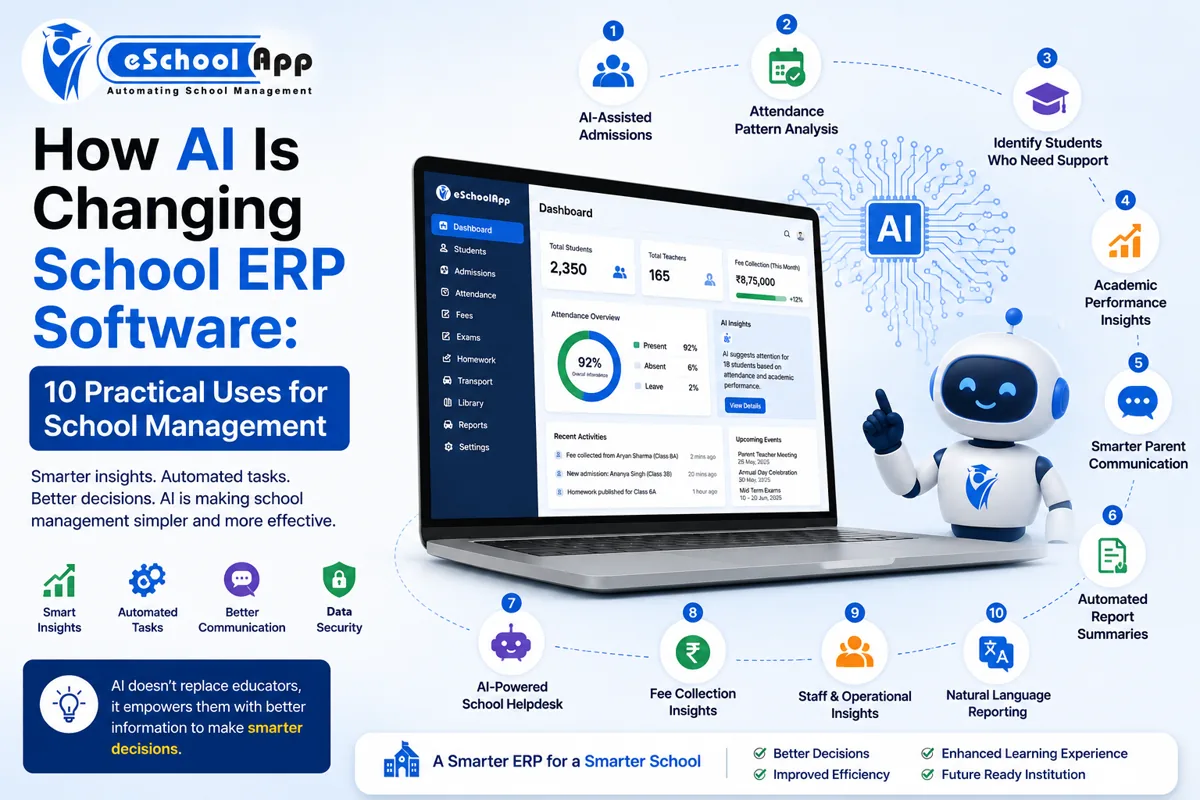
10 Practical Uses of AI in School ERP
1. AI-Assisted Admissions
AI can potentially help schools analyze enquiry sources, follow-up activity, conversion rates, admission trends, and frequently asked questions. An AI assistant can also help staff respond to routine questions about admissions, documents, schedules, and procedures.
2. Attendance Pattern Analysis
An intelligent system could help identify repeated absences, sudden attendance decline, frequent late arrivals, and class-level attendance patterns.
3. Identifying Students Who May Need Support
AI can potentially identify combinations of signals such as declining marks, lower attendance and missing assignments that deserve human review. These should be treated as early-warning signals, not final judgments.
4. Academic Performance Insights
AI can help summarize class performance, subject performance, changes over time, areas where students are struggling and common assessment patterns.
5. Automated Report Summaries
AI can summarize large management reports so that decision-makers can see what deserves attention faster.
6. Parent Communication
AI can assist in drafting or personalizing routine communication related to attendance, homework, events, fee reminders, general notices and academic updates.
7. AI-Powered School Helpdesk
An AI assistant could answer routine questions about fee deadlines, receipts, examinations, homework, admission documents and school notices using approved school information.
8. Fee and Collection Insights
AI can help management understand collection trends, outstanding amounts, payment patterns and changes over time.
9. Staff and Operational Insights
AI can potentially help identify patterns in staff attendance, leave, workload indicators and staffing gaps. Such insights should support, not automatically determine, employment decisions.
10. Natural-Language Reporting
One of the practical uses of AI may be asking questions in normal language, such as “Show me the fee collection status for this month” or “Which classes have attendance below our target?”
AI Should Complement School ERP, Not Replace It
AI is only as useful as the information available to it.
If student information is spread across Excel files, separate attendance software, different communication tools and paper records, AI cannot magically create a reliable picture of the school.
This is why integrated ERP architecture matters.
A centralized school system creates a more consistent information base. eSchoolApp’s platform brings modules such as admissions, student information, fees, attendance, examinations, communication, transport, staffing and management reporting into one system.
That connected data structure is important for any intelligent analytics layer.
What AI Does in eSchoolApp Today
The uses described above are what AI can do in school ERP software generally. Four AI capabilities are available in eSchoolApp today:
- AI-enabled student reports
- Sentiment analysis
- Assignment evaluation
- An AI-based learning management system
As with any vendor, the useful next step is the one this article recommends throughout: ask for a live demonstration and see how each one works with your school’s own data.
What AI Should Not Do in a School
AI has significant potential, but schools should be careful about how it is used.
AI should not automatically make high-impact decisions such as expelling students, rejecting admissions, determining disciplinary action, making employment decisions or assigning medical conclusions.
AI should not replace teachers. Teachers understand students in ways that cannot be captured completely in databases. AI can assist teachers with information and administration; it should not replace their professional judgment.
AI should not become an excuse for poor data governance. Schools should understand where data is stored, who can access it, how information is processed, what information is shared with AI services, how access is controlled and how long data is retained.
How Should Schools Evaluate AI in an ERP?
Do not ask a vendor simply, “Does your ERP have AI?”
Instead ask:
What does the AI actually do? Ask for a live demonstration.
What data does it use? Understand the source of its information.
Can staff verify its output? Important summaries or recommendations should be reviewable.
Can access be controlled? Not every employee should have access to all school data.
Is AI included in the subscription? Clarify pricing.
Is our data used to train external models? This is an important question when evaluating any AI-powered service.
AI + School ERP: What the Future Could Look Like
The future school ERP may become less about manually opening individual modules and more about asking the system for information.
Imagine a principal beginning the morning with:
“Give me a summary of anything important that needs my attention today.”
The ERP could potentially surface admission issues, attendance changes, pending fees, transport alerts, staff issues, academic concerns and important communications.
The technology would not make the decisions. It would help the decision-maker see what needs attention faster.
That is a much more practical vision for AI in school management than simply adding an “AI” label to existing software.
Frequently Asked Questions
What is AI in school ERP software?
AI in school ERP refers to using artificial intelligence to analyze school information, automate selected tasks, generate summaries, and assist administrators, teachers, and other authorized users.
Can AI predict student performance?
AI can potentially identify patterns in attendance, assessments, and other information that may indicate a need for attention. Such insights should be treated as indicators rather than definitive predictions.
Can AI automate school communication?
AI can assist in drafting and personalizing routine communication. Schools should maintain appropriate human review for important messages.
Is AI necessary in school ERP software?
Not every school needs advanced AI capabilities immediately. Strong core ERP workflows, reliable data, and good user adoption should come first.
Is AI safe for school data?
Safety depends on the technology architecture, permissions, security controls, data handling practices, and the AI services being used. Schools should ask vendors detailed questions before enabling AI features.
Final Thoughts
AI is likely to become an increasingly important part of school management software.
But the most useful AI will not necessarily be the most complicated.
The biggest value may come from simple capabilities that help school staff find information faster, identify patterns earlier, automate repetitive work, and make better-informed decisions.
The foundation remains a connected and reliable school ERP.
AI can then build on that foundation.
Want to see how a connected school management system can support your school’s next stage of digital transformation?
Book an eSchoolApp demo: https://eschoolapp.com/contact/